
Through children’s eyes: Exploring human diversity through picture books
Sarah Louise Nelson, Education & Care Services Coordinator
Lisa Waters, Educational Leader
Maroondah City Council
Introduction
Early childhood education and care (ECEC) settings are often the first public spaces where children encounter difference beyond their immediate family and community (University of Melbourne, 2025). In these spaces, children begin to form understandings about who belongs, whose stories matter, and how diversity is named, valued, or ignored. In a time of increasing social and political polarisation, this places significant responsibility (and opportunity) on early childhood educators to engage with complexity in ways that are ethical, inclusive, and developmentally appropriate (UoM, 2025).
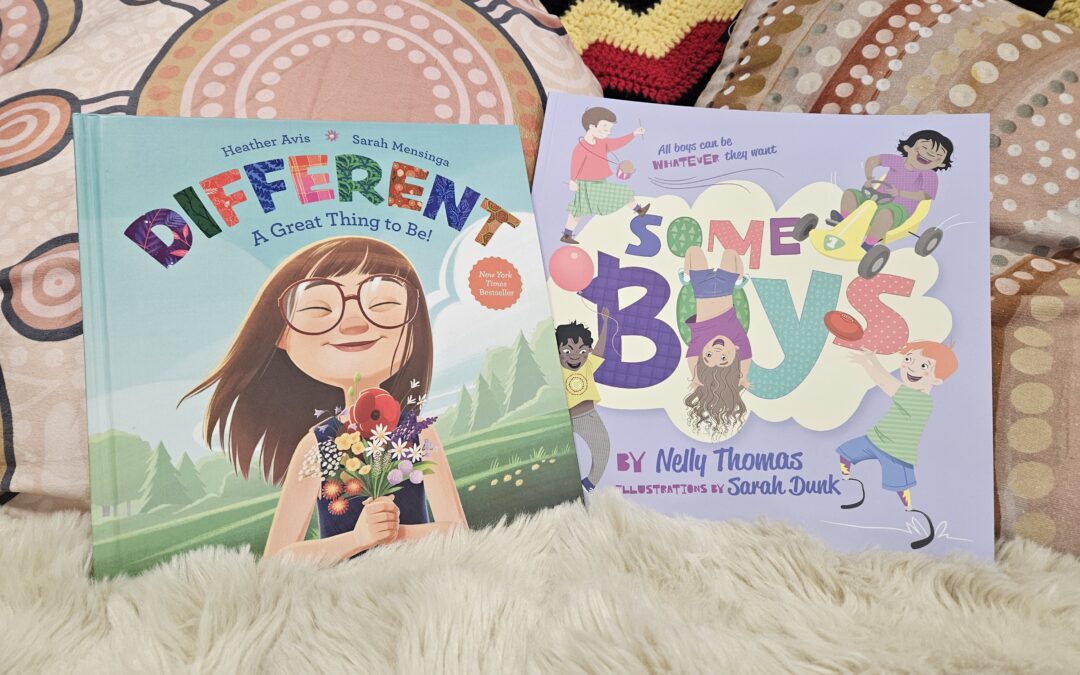
This article shares insights from an action research project undertaken by Sarah Louise and Lisa from Maroondah Occasional Care, a multi-age long day care setting catering to children aged birth to five located in Naarm (Melbourne). The project was made possible by a generous grant from AGECS to purchase a large collection of picture books. Picture books were selected off the Anti-Bias Catalogue, developed by Alistair Gibbs. The project explored how picture books could be used as a pedagogical tool to support children’s understandings of human diversity, while also strengthening educators’ capacity to reflect critically on their own practice. In doing so, the project became not only a learning experience for children, but also an act of professional bravery and pedagogical risk-taking.
Why picture books and action research?
Picture books are powerful cultural artefacts (Kim & Short, 2019). They offer children windows into experiences beyond their own and act as mirrors that reflect their identities and communities (Crawford et al, 2024). In this project, Sarah Louise and Lisa intentionally selected books that represented a range of identities and lived experiences, including disability, neurodiversity, Aboriginal and Torres Strait Islander perspectives, cultural and linguistic diversity, and gender identity and expression.
Rather than delivering a pre-determined ‘program’, Sarah Louise and Lisa adopted an action research approach (Roberts-Holmes, 2005) using the picture books and series of age-appropriate reflective questions as provocations; listening to and observing children’s verbal and non-verbal responses; inviting children to draw their ideas; documenting and assessing learning; and engaging in ongoing reflection as leaders. This cyclical process allowed their practice to evolve in response to what children actually said and did, rather than what was assumed they understood.
Project discoveries
The project revealed much about the values and learning culture that had already been established within the service. Children demonstrated confidence and empathy when discussing cultural and linguistic diversity, disability, and neurodiversity, often drawing on languages of access, fairness, and support.
“Everyone can do different things and be happy like me” – Child aged 5
“Sometimes when they have really brown skin, people walk away in the shops” – Child aged 4
“Its not ok when people are not nice or being mean to people because they don’t look the same as you or they come from another place and they talk different” – Child aged 5
“When people feel different it makes them feel sad. It can make them feel scared” – Child aged 5
Similarly, engagement with First Nations stories reflected a depth of familiarity and respect, suggesting that ongoing work in this space had been meaningful, sustained, and deeply embedded in service life.
“We are Wurundjeri Country at the centre and at the building” – Child aged 4
“I think my family were not here first, the Aboriginal people were” – Child aged 5
“I know the crow is Waa because he comes to our playground outside” – Child aged 4
“The said it was nobody’s land but that’s not true. It’s everyone’s land to walk on” – Child aged 5
However, the research also surfaced an important gap that has led to further pedagogical dialogue. When picture books explored gender identity, expression, or non-stereotypical roles, children’s responses were more tentative. Stereotypical statements emerged: about who could wear certain clothes, play particular roles, or behave in specific ways.
“I don’t wear a skirt because I’m a boy” – Child aged 4
“A boy can run faster than a girl” – Child aged 4
“Girls can do things. But not play football” – Child aged 4
These moments were not viewed as ‘failures’ but, instead, as valuable, reflective data and evidence of where further pedagogical attention was needed.
Importantly, these findings prompted Sarah Louise and Lisa to ask difficult questions of themselves and their leadership: Which forms of human diversity were prioritised in the educational program, and which had been unintentionally sidelined, and why? Were some topics easier to engage with than others in this unique ECEC context? Had ‘fear of getting it wrong’ or ‘upsetting people’ limited professional risk-taking?
Pedagogical risk-taking
Engaging with children’s emerging understandings of gender diversity required Sarah Louise and Lisa to hold space for uncertainty, reflect on perceived community concerns, and challenge their own assumptions about what should be valued within an educational program for children aged birth to five years. This is where the project intersected strongly with notion of pedagogical risk-taking (Cooke, 2024; Cooke et al, 2020). Rather than avoiding discomfort, Sarah Louise and Lisa made a bold plan to use reflective dialogue, professional reading, and collaborative planning to strengthen their approach to leading discussions about the whole spectrum of human diversity.
Action research provided a necessary framework that legitimised this approach and supported the beginnings of change. Decisions were grounded in observation, deep reflection, and the Code of Ethics’ (Early Childhood Australia, 2016) commitment to equity, inclusion, and respect for diversity. The process reinforced that professional courage does not mean having all the answers but being willing to learn with and alongside children (Rose, 2021).
Supporting social cohesion in ECEC
By engaging children in conversations about difference through shared stories, the project supported social cohesion at a foundational level. Children practised listening, questioning, and considering perspectives other than their own: skills that are believed to be central to democratic participation. The learning environment became a space where difference could be noticed, named, and explored non-judgementally and with care.
For Sarah Louise and Lisa, the project reaffirmed that intentional, reflective practice strengthens both pedagogy and professional identity. Working in an action research-oriented way allowed them, as leaders, to celebrate strengths, address gaps, and align plans for daily practice with deeply held values.
Conclusion
This project highlights the power of picture books and action research to support inclusive practice in ECEC settings. More importantly, it demonstrates how pedagogical risk-taking, grounded in purpose, ethics, and reflection, can enable educators to engage meaningfully with complexity. In challenging times, such work is not optional; it is central to the role of ECEC in shaping more inclusive and connected futures.
Acknowledgement
To the Wurundjeri People of the Kulin Nation for their custodianship of the land in which this action research project took place.
To AGECS for their generous Diversity and Inclusion Grant that funded the purchasing of a large collection of picture books.
To Alistair Gibbs for his gift of the Anti-Bias catalogue.
To Maroondah City Council for their ongoing support of our pedagogical thinking.
References
Cooke, M. (2024). Conceptualizing risk-taking in educational settings for enabling pedagogies of courage. Contemporary Issues in Early Childhood, 0(0), 1-15. https://doi.org/10.1177/14639491231260919
Cooke, M., Press, F., & Wond, S. (2020). Educators’ risk-taking in high quality early childhood education. International Journal of Early Years Education, 33(2), 244-260. https://doi.org/10.1080.09669760.2020.1848531
Crawford, P. A., Killingsworth Roberts, S., & Lacinda, J. (2024). Picturebooks and young children: Potential, power, and practices. Early Childhood Education Journal, 52, 1273-1279. https://doi/org/10.1007/s10643-024-01701-0
Early Childhood Australia (2016). Code of Ethics. www.earlychildhoodaustralia.org.au/wp-content/uploads/2019/08/ECA-COE-Brochure-web-2019.pdf
Kim, H. Y., & Short, K. G. (2019). A picturebook as a cultural artifact. In H. Johnson, J. Mathis, & K. Short (eds.). Critical context analysis of visual images in books for young people. Routledge.
Roberts-Holmes, G. (2005). Doing your early years research project: A step-by-step guide. SAGE.
Rose, C. (2021). Democratic pedagogy in early childhood: A pracademic narrative. Carrie Rose Consualtancy.
University of Melbourne (2025). National best practice framework for early childhood intervention: Everyday settings. Practice guidance. www.health.gov.au/sites/default/files/2025-09/the-national-best-practice-framework-for-early-childhood-intervention-practice-guidance-everyday-settings-key-principle.pdf