
By Teresa Stella-Bagnara (AGECS Fellow 2024)
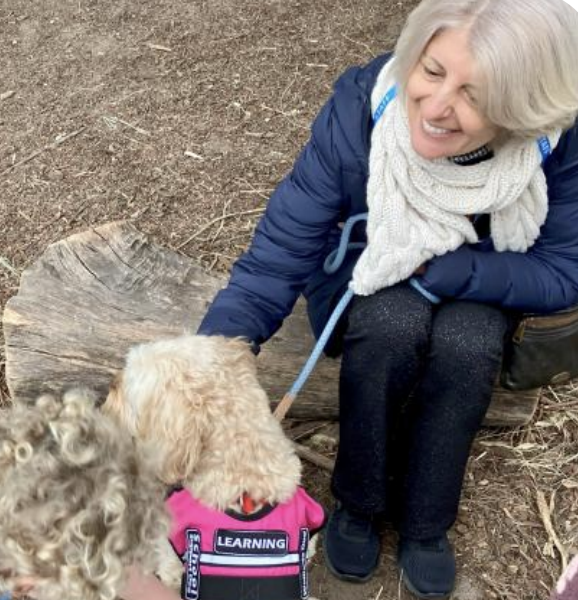
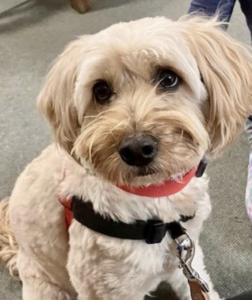
As part of my AGECS Fellowship for Leadership and Change, I introduced Penny Lane, a Groodle in training as an education assistant dog, to a metropolitan kindergarten three-year old group in 2024. The intention was to explore how a visiting dog program can support children’s wellbeing, while also trialling resources that embed the program into everyday practice and can be adapted by other services.
Why certified visiting dogs?
Research demonstrates that animal-assisted programs can reduce stress and support children’s capacity for self-regulation (Beetz et al., 2012). Dogs help foster empathy, trust, and prosocial behaviours (Bone, 2013) and are shown to increase motivation for participation in learning activities. In early years settings, the presence of a dog has been linked to improved classroom atmosphere and positive peer interactions (Jalongo, 2015).
Other AGECS Fellows have also highlighted these benefits: Zeeman’s work with Ginny at Elsa MacLeod Kindergarten and Fruin’s project with Gus at Gowrie both confirmed that therapy and companion dogs can enhance literacy, wellbeing, and community engagement. This fellowship builds on that evidence base by trialling a model that incorporates policy alignment, family involvement, and practical educator resources.
Certification and training are essential for therapy dogs and their handlers. Organisations like Lead The Way Institute offer structured certification programs that ensure dogs are temperament-tested, handler teams are educated in animal welfare, stress recognition, and safe interaction practices. Certified dogs meet standards of behaviour, obedience, health, and socialisation that are necessary for school and early learning settings. Without such training, risks increase — including the welfare of the dog, the safety of children, and the ability of the handler to manage unexpected situations.
Through certification, Penny Lane can work in ways that align with the Department of Education’s Animals – Wellbeing & Engagement Policy, Service Animals Australia’s standards, and government-supported wellbeing dog frameworks, such as the Victorian Schools Mental Health Fund & Menu. This ensures not only safety and consistency but also credibility, accountability, and sustainability of the visiting dog program
Bringing Penny into the Program
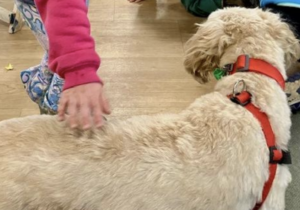
Before Penny visited, I prepared children and families with an introductory poster and encouraged the team to use books and discussions to set the scene. A learning story, ‘Kindergarten Adventures with Penny Lane’, mirrored the children’s group experiences and reinforced respectful interaction. Clear guidelines for engagement were explained, ensuring children approached Penny calmly and gently. Penny’s welfare was prioritised with short visits, access to breaks, and full handler supervision.
Educator Perspectives
Educators were highly supportive of Penny’s visits. In a survey of eight participants, 100% reported that children were very engaged. They observed calmer group behaviour, stronger empathy, and more peer sharing. Educators noted Penny created opportunities for prosocial communication, with children enthusiastically sharing their own animal stories and experiences.
Families were also drawn into the program. Educators reported that children retold stories about Penny at home, extending the impact beyond the classroom. As one educator commented: “Penny gave the children opportunities for prosocial communication, and they loved sharing their own animal stories with each other.”
Resources that support learning
To support learning, I developed a suite of resources:
– Learning story: ‘Kindergarten Adventures with Penny Lane’ provided continuity and reflection.
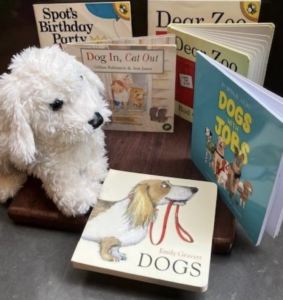
– Storybooks about pets and helper dogs: offered familiar narratives to build empathy and understanding.
– Puppy puppet: helped build children’s confidence and provided a playful entry point. – Introductory poster: prepared children and families for Penny’s visits.
– Implementation checklist: a practical tool to guide services through preparation, risk management, consent, animal welfare, curriculum links, and monitoring.
These resources anchored Penny’s visits within the curriculum, supported literacy and empathy, and were highly valued by educators as ‘very useful.’
Key Considerations
The program was guided by the Department of Education’s Animals – Wellbeing & Engagement policy. Key considerations included: – Risk assessment and parental consent. – Sensitivity to cultural perspectives on dogs. – Allergy and hygiene management. – Prioritising Penny’s wellbeing at all times. – Drawing on the Responsible Pet Ownership (RPO) program, a Victorian Government initiative run by Animal Welfare Victoria, which supports children to learn safe and respectful ways of interacting with dogs.
By addressing these factors, the program was delivered safely, inclusively, and in line with best practice.
Looking Ahead
The program will continue in Term 4, 2025 and Term 1, 2026, with Penny progressing along her certification pathway. I plan to expand data collection to include more educators and families, and to document case studies of children’s experiences. Refined resources, such as the checklist and learning story, will be shared with networks and professional forums.
Conclusion
Early outcomes from this fellowship confirm that visiting dog programs can enhance children’s wellbeing and support educators in practice. Through Penny Lane’s visits, the three-year-old group demonstrated empathy, responsibility, and engagement. Educators valued the resources, families became engaged, and staff noted a positive impact on the learning environment.
With strong policy alignment, welfare safeguards, and practical tools developed, this project contributes to a growing body of evidence supporting animal-assisted programs in early childhood. It provides a replicable model that can be adapted by other services and networks across Victoria.
References
Bone, J. (2013). The Animal as Fourth Educator: a literature review of animals and young children in pedagogical relationships. Australasian Journal of Early Childhood.
Jalongo, M. R. (2015). An attachment perspective on the child–dog bond: Interdisciplinary and international research findings. Early Childhood Education Journal, 43(5), 395-405
This article was originally published in AUDAX Spring 2025.